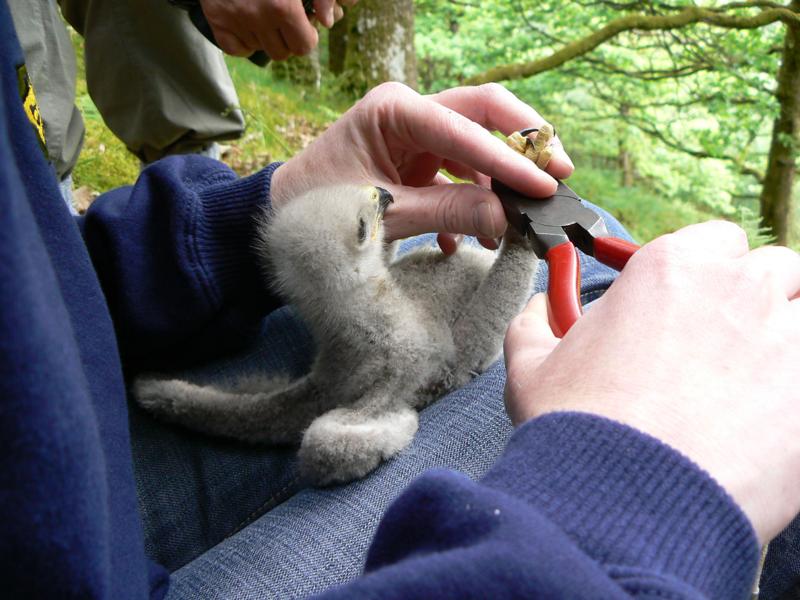
We had a great morning today, thanks to all. The totals were 176 Black-headed Gull chicks ringed and 17 Common Terns.
Kev
Pics from Tim & Gary
Saturday, 12 June 2010
Thursday, 10 June 2010
Tuesday, 8 June 2010
Wales report
We had a great sunny day in Wales, driving out of the miserable weather in Notts. We timed the visit just about right, no birds had fledged and only about 8 boxes remain with small chicks/eggs. We failed to hear Wood Warblers singing, however Tim found a nest and we did catch the male, but unfortunately the chicks were too small to ring. The Pied Flycatcher box occupancy was down, I think, but those that nested generally had good brood sizes.
The totals were:
Pied Flycatcher: 199 pulli ringed, 7 adults ringed, 2 adults retrapped
Redstart: 15 pulli ringed
Wood Warbler - 1 adult ringed
Buzzard - 1 pullus ringed
The two retrap birds were returning pulli from 2005 and 2008.
Meisha ringed the Buzzard - she now has a new favourite bird.
Photos to follow!
Kev
The totals were:
Pied Flycatcher: 199 pulli ringed, 7 adults ringed, 2 adults retrapped
Redstart: 15 pulli ringed
Wood Warbler - 1 adult ringed
Buzzard - 1 pullus ringed
The two retrap birds were returning pulli from 2005 and 2008.
Meisha ringed the Buzzard - she now has a new favourite bird.
Photos to follow!
Kev
Yellowhammer nest
Another trilogy of nest photos, this time a Yellowhammer from eggs on 17 May to ringing the 4 chicks on 4 June.
Mick P
Mick P
Monday, 7 June 2010
Sunday, 6 June 2010
Belvoir Barn Owls
In the last couple of years we have been collaborating with the recently formed Vale of Belvoir Barn Owl Conservation Group, masterminded by Don Pritchett. They cover an area of c75 square miles in north-east Leics from Bottesford to Melton. So far they have put up about 65 boxes and they monitor another 15 or so. They plan to fit another 20 or so to complete the project. The following summary is from Don:
In 2009 we had 10 confirmed pairs and 4 probables. For 2010 the current estimate is 19 pairs. Generally breeding is about 1-2 weeks later than last year with exception of one pair who had 3 young 3-4 weeks earlier than most. There is also Some indication of deferred breeding or no breeding. For example, a female at Barkestone weighed 300g when ideally she needed to have weighed 380-430g to breed.
An increase in winter use of boxes in all areas by Barn Owls has been noted and we also have 2 Tawny Owls and 4 Kestrels. 3 of the new boxes near Long Clawson have Barn Owls in already.
Early ringing (and examination of birds by ringers) information from 2009 and this year shows a high incidence of one or both adults caught this year being first year birds. Also, birds ringed elsewhere by SNRG and RUBOP have started to turn up in our boxes.
Monitoring costs are part sponsored for 2010 and 2 further years by the Leicester and Rutland Ornithological Society.
Thanks to Keith for the photos.
In 2009 we had 10 confirmed pairs and 4 probables. For 2010 the current estimate is 19 pairs. Generally breeding is about 1-2 weeks later than last year with exception of one pair who had 3 young 3-4 weeks earlier than most. There is also Some indication of deferred breeding or no breeding. For example, a female at Barkestone weighed 300g when ideally she needed to have weighed 380-430g to breed.
An increase in winter use of boxes in all areas by Barn Owls has been noted and we also have 2 Tawny Owls and 4 Kestrels. 3 of the new boxes near Long Clawson have Barn Owls in already.
Early ringing (and examination of birds by ringers) information from 2009 and this year shows a high incidence of one or both adults caught this year being first year birds. Also, birds ringed elsewhere by SNRG and RUBOP have started to turn up in our boxes.
Monitoring costs are part sponsored for 2010 and 2 further years by the Leicester and Rutland Ornithological Society.
Thanks to Keith for the photos.
Holme Pierrepont, Sat 5 June
After several days of scorching weather, our only concern was how quickly it might become too hot to ring. In the end it was getting that way by about 10:30, and we started taking down, dripping with sweat, soon after 11:00. It's incredible how quickly the water levels have dropped too, with the gravel pits already being much lower than when we opened up in April.
Anyway, we finished up on 81 birds in about 3 hours ringing. A couple of flocks of young Long-tailed Tits helped boost this figure, though only a handful of other youngsters were caught including Reed Bunting, Dunnock, Robin, Blue Tit and Chaffinch. Two Whitethroat 1Js were together high up in a mist net and appeared to fly strongly, despite having barely half-grown wings! A couple of retrap Reed Warblers and Blue Tits will be worth looking up as they were several years old and many other adults were looking battered and worn thanks to the trials of parenthood. I know how they feel...
All eight common warblers found their way into the nets (including this Lesser Whitethroat above), though Grasshopper Warblers have eluded us so far this year, though they would appear to be breeding on site as we heard reeling regularly through the morning. Whether or not any Cetti's Warblers survived the harsh winter remains to be seen as we still haven't heard or seen one yet. A single Cuckoo called from time to time, but there have been no multiple sightings yet this year. A few Black-headed Gulls were knocking about, possibly failed breeders, but we've not seen and Common Terns yet.
Lastly, the first big flush of Common Blue Damselflies was in full swing with thousands in amongst the grass and many busy mating.
Pete
Anyway, we finished up on 81 birds in about 3 hours ringing. A couple of flocks of young Long-tailed Tits helped boost this figure, though only a handful of other youngsters were caught including Reed Bunting, Dunnock, Robin, Blue Tit and Chaffinch. Two Whitethroat 1Js were together high up in a mist net and appeared to fly strongly, despite having barely half-grown wings! A couple of retrap Reed Warblers and Blue Tits will be worth looking up as they were several years old and many other adults were looking battered and worn thanks to the trials of parenthood. I know how they feel...
All eight common warblers found their way into the nets (including this Lesser Whitethroat above), though Grasshopper Warblers have eluded us so far this year, though they would appear to be breeding on site as we heard reeling regularly through the morning. Whether or not any Cetti's Warblers survived the harsh winter remains to be seen as we still haven't heard or seen one yet. A single Cuckoo called from time to time, but there have been no multiple sightings yet this year. A few Black-headed Gulls were knocking about, possibly failed breeders, but we've not seen and Common Terns yet.
Lastly, the first big flush of Common Blue Damselflies was in full swing with thousands in amongst the grass and many busy mating.
Pete
Friday, 4 June 2010
Sunday, 30 May 2010
Attenborough CES, Visit 4
We started in bright sunshine and with a moderate breeze, the sun stayed pretty constant but the breeze increased considerably. Despite this we ended with over 50 birds including 11 retraps. The first 3J Chiffchaffs of the year were caught along with a sprinkling of other juveniles of resident species and the first Treecreeper of the year. Ominously the residents of the tit boxes have started to fledge so the next session may be busy!
Kev
Kev
Friday, 28 May 2010
Drama in Harby
This Sparrowhawk just caught a Collared Dove against the window within inches of my face! It then hopped across the road a bit and only flew off (with difficulty) when a cat approached to investigate...
Pete
Pete
Thursday, 27 May 2010
High-rise housing
Just been in Stathern checking boxes and ringed 2 Tawny chicks in a Barn Owl box that was fixed to the side of a telegraph pole. On top of the same pole was an old square Barn Owl box containing a Kestrel on 4 eggs just a few feet away!
Pete
PS Tawny nest contained an FM Song Thrush chick and 3J Starling but no mammal remains.
Pete
PS Tawny nest contained an FM Song Thrush chick and 3J Starling but no mammal remains.
Dunnock nest
A great set of three pics from Mick P charting the progress of a Dunnock nest. Mick's being all humble and sending me photos 'only to put on if you think they are worth it'. Of course they are worth it Mick. Dunnock nests aren't always easy and I bet there are several group members who've not even seen one, let alone taken pictures at several stages. Consider your trumpet blown Mick!
17 May
24 May
26 May - when ringed
Subscribe to:
Posts (Atom)