Owing to a big event being held at the Water Sports Centre last weekend we went for a midweek session at Holme Pierrepont this week. Duncan, Gary and I set all but one of the usual nets under a grey sky with a light breeze blowing. The site and particularly the reed beds sounded quiet. Catching was steady but not spectacular and the breeze increased during the session but we ended on 56 (45 new/11 retrap) made up of: Blackbird 1/1, Dunnock 1/1, Wren 3/0, Robin 5/0, Blackcap 8/1, Garden Warbler 5/1, Whitethroat 2/1, Reed Warbler 4/2, Sedge Warbler 2/0, Chiffchaff 1/0, Willow Warbler 1/0, Long-tailed Tit 1/1, Blue Tit 5/2, Great Tit 3/1, Bullfinch 1/0, Reed Bunting 2/0. The oldest retraps was a Blackbird from 2009, which we had not seen again until today.
We were pondering on what was missing and having had a quick look at the last two years catches at this time of year and one from further back I came up with the following:
Today 56 birds, 28 of which were warblers (50%) and 57% of the warbler catch were juvs.
2014 94 birds, 61 of which were warblers (65%) and 75% of the warbler catch were juvs.
2013 88 birds, 53 of which were warblers (60%) and 66% of the warbler catch were juvs.
2009 140 birds, 101 of which were warblers (72%) and 80% of the warbler catch were juvs.
So not only did we catch less than other years but the number of warblers is well down on previous years and the percentage of warblers that were juvs was also down. Particularly noticeable was the lack of Reed Warblers, at this time of year they would normally make up 30-60% of the total catch but today it was just 10%.
Other birds around were Oystercatcher, Buzzard, Green Woodpecker, Cetti’s Warbler and a calling Cuckoo.
Kev

Thursday, 9 July 2015

Sparrowhawks
I have found this year pretty poor for nest recording. Not only have I struggled to find many nests most of the ones I have found have failed at some point. Therefore I was particularly pleased that this Sparrowhawk nest was successful (well almost!).
The nest was found on 27/05/2015 and contained 5 warm eggs, these were still there on the 09/06/2015.
I hoped I could plan my next visit right and there would be chicks which were big enough to ring. This is particularly important with sparrowhawks due to the different ring sizes for the sexes, it also prevents too many visits, minimising any disturbance.
A visit on the 26/06/2015 resulted in 4 chicks and an addled egg. The age of the chicks allowed them to be sexed and the appropriate ring fitted. All the chicks were equally developed with yellowish legs, approx. 10 mm of primary feather, a few mm of tail feather showing and a few contour feathers just becoming visible. There were 2 males weighing 110 and 125 grams and 2 females weighing 165 and 170 grams. The average weights for adult sparrowhawks are 150 grams for males and 260 grams for females.
Further discrete visits from a distance on 04/07/15 and 08/07/2015 showed all the chicks looking well and standing on the nest. I apologise for the poor “digiscope” photo taken on the 08/07, it was the best view I could get.
I may carry out one more discreet visit in a few days before submitting the nest record which will make a valuable contribution to the 60 or so submitted to the BTO each year.
Mick P


The nest was found on 27/05/2015 and contained 5 warm eggs, these were still there on the 09/06/2015.
I hoped I could plan my next visit right and there would be chicks which were big enough to ring. This is particularly important with sparrowhawks due to the different ring sizes for the sexes, it also prevents too many visits, minimising any disturbance.
A visit on the 26/06/2015 resulted in 4 chicks and an addled egg. The age of the chicks allowed them to be sexed and the appropriate ring fitted. All the chicks were equally developed with yellowish legs, approx. 10 mm of primary feather, a few mm of tail feather showing and a few contour feathers just becoming visible. There were 2 males weighing 110 and 125 grams and 2 females weighing 165 and 170 grams. The average weights for adult sparrowhawks are 150 grams for males and 260 grams for females.
Further discrete visits from a distance on 04/07/15 and 08/07/2015 showed all the chicks looking well and standing on the nest. I apologise for the poor “digiscope” photo taken on the 08/07, it was the best view I could get.
I may carry out one more discreet visit in a few days before submitting the nest record which will make a valuable contribution to the 60 or so submitted to the BTO each year.
Mick P


Sunday, 28 June 2015
Attenborough CES, Session 6, Saturday 27 June
The sixth and final CES session for 2015 was carried out on Saturday. The forecast was good for Saturday but poor for Sunday and for once it was correct, the session was held in dry, calm and sunny conditions. The warm sun may not have helped us catch birds but it certainly kept the mosquitoes at bay. The team this week was Gary, Duncan, Alex, Tom and myself.
Another decent catch but still not many warblers and other than a single Reed Warbler there were no other juvenile warblers. Wrens, however, seem to be having a great season with 8 caught on this visit.
Total catch was (new/retrap) 36/8 made up of: Blackbird 0/1, Dunnock 0/1, Wren 6/2, Robin 4/0, Blackcap 6/2, Reed Warbler 4/0, Chiffchaff 1/1, Blue Tit 2/1, Great Tit 3/0, Bullfinch 10/0. The retraps were all relatively recent, the oldest being a Blackbird and Blackcap from 2012.
Kev
Another decent catch but still not many warblers and other than a single Reed Warbler there were no other juvenile warblers. Wrens, however, seem to be having a great season with 8 caught on this visit.
Total catch was (new/retrap) 36/8 made up of: Blackbird 0/1, Dunnock 0/1, Wren 6/2, Robin 4/0, Blackcap 6/2, Reed Warbler 4/0, Chiffchaff 1/1, Blue Tit 2/1, Great Tit 3/0, Bullfinch 10/0. The retraps were all relatively recent, the oldest being a Blackbird and Blackcap from 2012.
Kev
Saturday, 27 June 2015
Kestrels
Following a tip off from a local gamekeeper I managed to find a Kestrel nest in a cavity in an old tree which contained 4 large chicks. One of the benefits of ringing chicks when they are large is that their plumage is more developed allowing many to be sexed.
Reading the “Identification Guide to European Non-Passerines” by Kevin Baker it says, of juvenile and 1st winter Kestrels -
“Some juveniles cannot be sexed with certainty early on but all should be sexable by December having acquired some adult feathers. However, at any age, those with grey heads or grey rumps, uppertail-coverts and tail are males”.
That would lead me to think that this bird is a male and the other three female. It was lighter too weighing only 190g whilst the others were 205-225g.
Mick P


Reading the “Identification Guide to European Non-Passerines” by Kevin Baker it says, of juvenile and 1st winter Kestrels -
“Some juveniles cannot be sexed with certainty early on but all should be sexable by December having acquired some adult feathers. However, at any age, those with grey heads or grey rumps, uppertail-coverts and tail are males”.
That would lead me to think that this bird is a male and the other three female. It was lighter too weighing only 190g whilst the others were 205-225g.
Mick P


Monday, 22 June 2015
100 and still counting...
I have quite a few Starlings feeding in the garden, not sure how many so thought I'd get a
few rings on some of them. This is number LH26248 - the one hundredth Starling ringed so far in my campaign and only 2
retraps.
Gary


Gary


Sunday, 21 June 2015
Attenborough CES, Session 5, Sunday 20 June
After missing the fourth CES session because of the poor weather, we attempted the fifth CES session today. This was also going to be a ringing demo in support of the Attenborough bio-blitz. The forecast was not good (again) and Tim held back on advertising the ringing demo because of it. Certainly the forecast last thing on Friday suggested we would not be able to go - but on waking early Saturday it was dry and calm. We erected all the nets in perfect conditions but it did start to drizzle half way through the session, enough at one point to make us close the nets for a while. When it stopped the nets were opened again.
The team this week was Gary, Duncan, Alex, Sue, Pete S and myself. Another decent catch but still not many warblers, but we did get the second Cetti’s of the year. A woodpecker and a couple of Goldcrests were nice additions to the usual catch and 11 Wrens gave some useful extraction practice.
Total catch was 47 (37 new/10 retrap) made up of: Great Spotted Woodpecker 1/0, Blackbird 1/0, Song Thrush 0/2, Dunnock 5/0, Wren 9/2, Robin 4/0, Blackcap 3/3, Garden Warbler 1/0, Reed Warbler 3/2, Cetti’s Warbler 1/0, Chiffchaff 2/1, Blue Tit 2/0, Great Tit 1/0, Bullfinch 2/0, Goldcrest 2/0.
The retraps were all relatively recent, the oldest being a Song Thrush from 2012.
Kev

The team this week was Gary, Duncan, Alex, Sue, Pete S and myself. Another decent catch but still not many warblers, but we did get the second Cetti’s of the year. A woodpecker and a couple of Goldcrests were nice additions to the usual catch and 11 Wrens gave some useful extraction practice.
Total catch was 47 (37 new/10 retrap) made up of: Great Spotted Woodpecker 1/0, Blackbird 1/0, Song Thrush 0/2, Dunnock 5/0, Wren 9/2, Robin 4/0, Blackcap 3/3, Garden Warbler 1/0, Reed Warbler 3/2, Cetti’s Warbler 1/0, Chiffchaff 2/1, Blue Tit 2/0, Great Tit 1/0, Bullfinch 2/0, Goldcrest 2/0.
The retraps were all relatively recent, the oldest being a Song Thrush from 2012.
Kev

Goldcrest (Alex Phillips)
Tuesday, 16 June 2015
Clifton Grove Little Owls
I received a phonecall from Rob Hoare last week to say that 4 Little Owl chicks were ready to be ringed at one of five boxes he has put up around the Clifton Grove area. Ian Blackmore used to ring these for us, but I will now be taking up monitoring these boxes.
On Thursday evening Gary and I joined Rob to ring the brood. The female was sat in the box so we got her out first and she was already ringed, perhaps the same female Ian ringed last year? The 4 chicks however had dwindled to 2, and a disembodied wing and leg suggested that the owls had resorted to cannibalism in order to survive. The remaining two chicks were ringed and seemed pretty healthy, so hopefully they will continue that way.
Cheers to Rob for inviting us to ring the birds, and thanks to Rachel Shock for the photos.
Tom


On Thursday evening Gary and I joined Rob to ring the brood. The female was sat in the box so we got her out first and she was already ringed, perhaps the same female Ian ringed last year? The 4 chicks however had dwindled to 2, and a disembodied wing and leg suggested that the owls had resorted to cannibalism in order to survive. The remaining two chicks were ringed and seemed pretty healthy, so hopefully they will continue that way.
Cheers to Rob for inviting us to ring the birds, and thanks to Rachel Shock for the photos.
Tom


Tuesday, 9 June 2015
Wales, Sunday 7 June
Gary, Mick P, Duncan, Tom, Sue and I made the trip to Wales on Sunday to ring the Pied Flycatcher chicks. We had again received varying reports about the season, suggesting our planned visit may be a little late and then a report on Friday suggesting we may be going a little early!
The weather was blue sky and sunshine all the way there and continued like that for the rest of the day. The lack of Buzzards in the wood over the last few years had given some concern but we saw plenty on the spring visit and two flew out of the wood as we arrived.
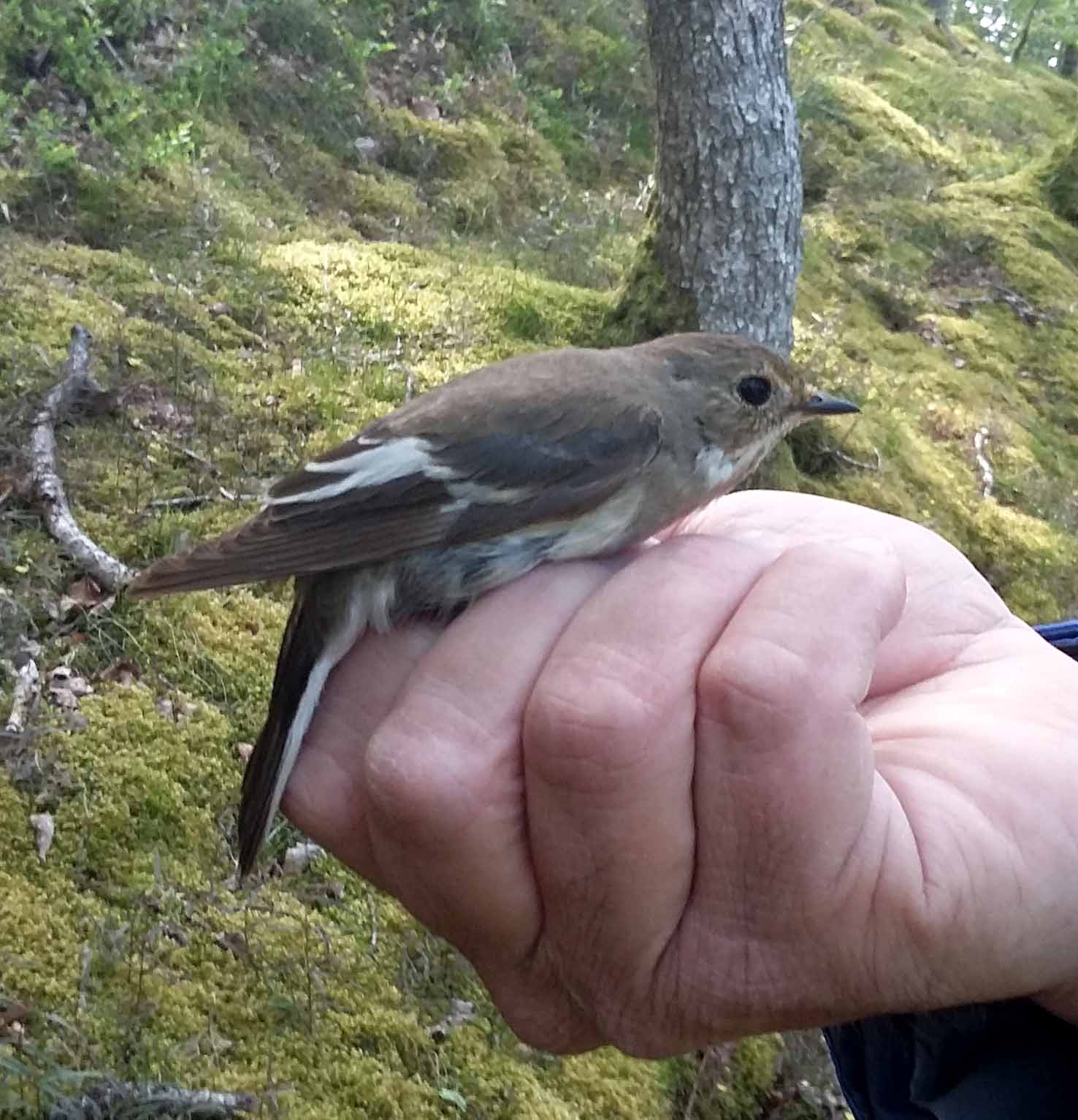
We decided that Sue and Tom would probably fare better ringing wise in the main wood as last year the 'Toilet Wood' was poor. So we set off checking the boxes, I went to Toilet Wood alone expecting to find very little but was surprised to find half the boxes occupied by Pied Flycatchers or Redstarts. All the pulli (other than 1 runt) in these boxes were at a suitable stage for ringing and I ended up ringing 40 Pied flycatcher chicks and 1 adult, plus a recapture and 8 Redstart chicks and 1 adult.
I set off to meet the others and continue to check the remaining boxes, expecting the day to be a bumper ringing day. How wrong I was as the other 110 boxes produced only 18 Pied Flycatcher chicks, 8 new adults and 4 recaptures – the chicks that were in these boxes were all too small. It means there should be approx 150 chicks to ring in 24 boxes early next week – anyone care to make a weekday trip?
We did manage to catch a Wood Warbler to end the visit but despite seeing the Buzzards on arrival we could find no active nest. We ended with 58 pulli Pied Flycatchers and 14 adults, 8 Redstart chicks and 1 adult plus a Wood Warbler. The oldest retrap was from 2010, two of the ringed birds were controls.
Thanks to Sue and Tom for the photos.
Kev


The weather was blue sky and sunshine all the way there and continued like that for the rest of the day. The lack of Buzzards in the wood over the last few years had given some concern but we saw plenty on the spring visit and two flew out of the wood as we arrived.
We decided that Sue and Tom would probably fare better ringing wise in the main wood as last year the 'Toilet Wood' was poor. So we set off checking the boxes, I went to Toilet Wood alone expecting to find very little but was surprised to find half the boxes occupied by Pied Flycatchers or Redstarts. All the pulli (other than 1 runt) in these boxes were at a suitable stage for ringing and I ended up ringing 40 Pied flycatcher chicks and 1 adult, plus a recapture and 8 Redstart chicks and 1 adult.
I set off to meet the others and continue to check the remaining boxes, expecting the day to be a bumper ringing day. How wrong I was as the other 110 boxes produced only 18 Pied Flycatcher chicks, 8 new adults and 4 recaptures – the chicks that were in these boxes were all too small. It means there should be approx 150 chicks to ring in 24 boxes early next week – anyone care to make a weekday trip?
We did manage to catch a Wood Warbler to end the visit but despite seeing the Buzzards on arrival we could find no active nest. We ended with 58 pulli Pied Flycatchers and 14 adults, 8 Redstart chicks and 1 adult plus a Wood Warbler. The oldest retrap was from 2010, two of the ringed birds were controls.
Thanks to Sue and Tom for the photos.
Kev



Starlings
I've been catching a few Starlings in the garden using spring traps. Always disappointing when
you only catch one at a time.
Gary

Gary

Monday, 1 June 2015
Recent Recoveries
The latest few batches of recoveries come as a bit of a mixed bag, with several species ringed by the group being represented.
Firstly, two Barn Owls. One was ringed at Clifton Wood as a nestling in September last year and found dead nearby at Burrows Farm in April this year. The other Barn Owl travelled a little further, being found dead as a road casualty in Cambridgeshire in April, 81km from where it was ringed as a chick in Elton in June last year.
An Attenborough-born Grey Heron, colour-ringed in June 2013 was re-sighted at Carsington Water in Derbyshire recently. It's encouraging to get some resightings of these colour-ringed birds, generating some useful data from this relatively new project for the group.
A Sparrowhawk which was caught as Jim was setting the nets in preparation for the Winter Thrush sessions in Flintham Orchard in December last year, was found dead in the village in May this year, supposedly caught by an animal...
A Whitethroat, ringed as a 3J at Holme Pierrepont in Aaugust 2014, was found dead in May this year the other side of Nottingham, in Bulwell. It goes to show that these young birds do sometimes show a preference for the area in which they were raised, as this one would have made the journey to Africa and back and was found not too far from where it was ringed.
A Jackdaw ringed as a nestling in Calverton in May last year met its end against some overhead wires in Bestwood, where it was found freshly dead in May this year.
And the latest recovery comes in the form of a Little Owl, found dead in Ruddington in May this year. It was ringed nearby in Keyworth as a chick in May last year.
Tom
Firstly, two Barn Owls. One was ringed at Clifton Wood as a nestling in September last year and found dead nearby at Burrows Farm in April this year. The other Barn Owl travelled a little further, being found dead as a road casualty in Cambridgeshire in April, 81km from where it was ringed as a chick in Elton in June last year.
An Attenborough-born Grey Heron, colour-ringed in June 2013 was re-sighted at Carsington Water in Derbyshire recently. It's encouraging to get some resightings of these colour-ringed birds, generating some useful data from this relatively new project for the group.
A Sparrowhawk which was caught as Jim was setting the nets in preparation for the Winter Thrush sessions in Flintham Orchard in December last year, was found dead in the village in May this year, supposedly caught by an animal...
A Whitethroat, ringed as a 3J at Holme Pierrepont in Aaugust 2014, was found dead in May this year the other side of Nottingham, in Bulwell. It goes to show that these young birds do sometimes show a preference for the area in which they were raised, as this one would have made the journey to Africa and back and was found not too far from where it was ringed.
A Jackdaw ringed as a nestling in Calverton in May last year met its end against some overhead wires in Bestwood, where it was found freshly dead in May this year.
And the latest recovery comes in the form of a Little Owl, found dead in Ruddington in May this year. It was ringed nearby in Keyworth as a chick in May last year.
Tom
Sunday, 31 May 2015
Holme Pierrepont, Saturday 30 May
Sue, Tom and I paid a visit to the Grange end of Holme Pierrepont on Saturday. There was a triathlon event on at the NWSC over the weekend but from the website it looked like Saturday would be the easier day to get in and park. The weather forecast also suggested that Sunday would be a washout and for once it was correct. However, on arrival at the usual car park there were attendants refusing entry but we noticed the old ‘B’ car park was open for spectators and was free to park so we headed for there.
On site the vegetation, away from the reedbeds, had gone wild and locating the guys and poles took quite a while but all were found eventually. Then we got to the reedbed nets and all was not well. To cut a long story short 5 poles had been taken and smashed. We found the remains of them and you may be able to see them in the following photographs. We found a large well constructed shelter and enormous hole in the the sandy area that has attracted campers in the past. The construction and hole was no small effort and I did think it was the work of adults, but looking through the rubbish left Tom found the cans were all pop not alcohol and so it may well have been kids.
We decided to limit the number of nets erected both for practical reasons and lack of poles but the sunny and breezy conditions meant the nets, particularly the couple we did put up in the reeds, were affected by the conditions.
The total catch was 21 (13 new/8 retrap) made up of: Blackbird 1/1, Dunnock 2/0, Wren 0/1, Robin 1/1, Blackcap 0/1, Garden Warbler 1/0, Sedge Warbler 2/1, Cetti’s Warbler 1/0, Chiffchaff 1/0, Willow Warbler 0/2, Blue Tit 0/1, Long-tailed Tit 4/0.
The retraps were all relatively recent, the oldest being from last year. Interestingly not a single Reed Warbler was caught and the reedbeds were very quiet. When we finished we hid the remaining poles somewhere else...
Kev


On site the vegetation, away from the reedbeds, had gone wild and locating the guys and poles took quite a while but all were found eventually. Then we got to the reedbed nets and all was not well. To cut a long story short 5 poles had been taken and smashed. We found the remains of them and you may be able to see them in the following photographs. We found a large well constructed shelter and enormous hole in the the sandy area that has attracted campers in the past. The construction and hole was no small effort and I did think it was the work of adults, but looking through the rubbish left Tom found the cans were all pop not alcohol and so it may well have been kids.
We decided to limit the number of nets erected both for practical reasons and lack of poles but the sunny and breezy conditions meant the nets, particularly the couple we did put up in the reeds, were affected by the conditions.
The total catch was 21 (13 new/8 retrap) made up of: Blackbird 1/1, Dunnock 2/0, Wren 0/1, Robin 1/1, Blackcap 0/1, Garden Warbler 1/0, Sedge Warbler 2/1, Cetti’s Warbler 1/0, Chiffchaff 1/0, Willow Warbler 0/2, Blue Tit 0/1, Long-tailed Tit 4/0.
The retraps were all relatively recent, the oldest being from last year. Interestingly not a single Reed Warbler was caught and the reedbeds were very quiet. When we finished we hid the remaining poles somewhere else...
Kev


Egrets and herons
Success yesterday with the Little Egrets. We ringed another 35 chicks at our Nottinghamshire heronry and most were fitted with colour rings. The Grey Herons had fared less well since our last monitoring visit with several large chicks succumbing to the unspring-like cold and wet weather we're having.
Jim


Jim


Wednesday, 27 May 2015
Attenborough CES, Session 3, Sunday 24 May
The third CES visit of the season was carried out on Sunday. The forecast was not good and it started to rain as we were putting up the first net but it lasted only five minutes leaving calm and overcast conditions for the rest of the session.
The team this week was Gary, Duncan, Tom, Linda and myself. Another decent catch but still not many warblers, although we did get the first Cetti’s of the year.
Total catch was 45 (25 new/20 retrap) made up of: Blackbird 2/0, Song Thrush 1/0, Dunnock 1/4, Wren 3/0, Robin 2/0, Blackcap 4/1, Reed Warbler 1/2, Cetti’s Warbler 1/0, Chiffchaff 1/4, Blue Tit 1/0, Great Tit 2/3, Long-tailed Tit 3/3, Bullfinch 1/1, Greenfinch 2/0, Treecreeper 0/2.
The retraps were all relatively recent, the oldest being a Reed Warbler from 2013.
Kev
The team this week was Gary, Duncan, Tom, Linda and myself. Another decent catch but still not many warblers, although we did get the first Cetti’s of the year.
Total catch was 45 (25 new/20 retrap) made up of: Blackbird 2/0, Song Thrush 1/0, Dunnock 1/4, Wren 3/0, Robin 2/0, Blackcap 4/1, Reed Warbler 1/2, Cetti’s Warbler 1/0, Chiffchaff 1/4, Blue Tit 1/0, Great Tit 2/3, Long-tailed Tit 3/3, Bullfinch 1/1, Greenfinch 2/0, Treecreeper 0/2.
The retraps were all relatively recent, the oldest being a Reed Warbler from 2013.
Kev
Thursday, 21 May 2015
Barn Owl update
I’ve just spent the last 3 days checking Barn Owl boxes in east Lincs. It looks
like a much later season than last year when birds had complete clutches by
early April. This year maybe half had started laying or had complete clutches,
some were just paired up and I suspect other regular sites have yet to be used. However, a 12 year old retrap male was a nice find. Anyway, based on this, I’m not going
to be checking local boxes until the first half of June.
The lateness is most likely down to be down to lack of food:
- lots of reports of birds hunting in the daytime
- some breeding females being underweight
- no voles to be found in sort of owl box as yet
Jim
Wednesday, 20 May 2015
Tawnys again
I ringed what will almost certainly be my final Tawny Owl chick of the year tonight. That makes a grand total of three this season... It wasn't the fattest chick either and there was no food cached in the box. Interestingly, the box is part of a double-decker arrangement. It's at the top of a pole which has another box below. In most years, both boxes are occupied by something and I have had kestrels in the top and Tawny Owls in the bottom at the same time before. When I first checked this year there was a Jackdaw nest in the bottom box. Subsequent checks revealed an adult Jackdaw carcass in the Tawny's nest and a clutch of cold Jackdaw eggs below. One can only guess the story...
Pete


Pete


Subscribe to:
Posts (Atom)