

Monday, 9 April 2018
2017 Report
The 2017 ringing report is now out. If you would like a copy, please email the address at the top of the 'Reports' page - see tab at the top.


Brackenhurst, Sunday 8 April
Always interesting to ring at this time of year, with wintering birds packing their bags to go home and putting on fat, whilst residents are getting ready to breed and the spring warblers are arriving.
Duncan, Tom and I had a lovely morning at Brack yesterday with calm, overcast weather, and a steady flow of birds. We handled 66 birds of 13 species. Highlights were:
The oldest retrap was a Chaffinch from 2014. The Willow Warbler was the fifth for the site and the first since 2011. Only three Blackcaps have been caught previously, one of which had been wintering. Lastly, we rather unexpectedly flushed a pair of Mallard in the copse and the female only narrowly evaded capture when she bounced out of the net.
Jim

Duncan, Tom and I had a lovely morning at Brack yesterday with calm, overcast weather, and a steady flow of birds. We handled 66 birds of 13 species. Highlights were:
- A female Blackcap control (i.e. ringed elsewhere). The Blackcaps had been eating berries, we think Ivy, (see picture). This is something usually associated with autumn birds.
- Our first Swallow of the year sighted.
- Half the catch was our target species, Yellowhammer. Most of the adult males were developing cloacal protuberances.
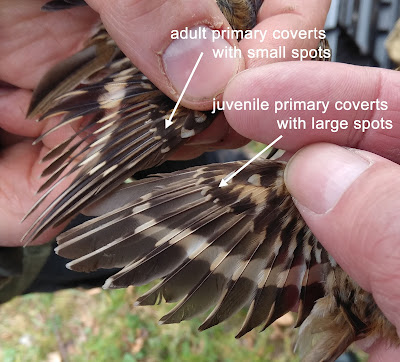
- A ‘pair’ of Treecreepers. These can be aged by the size of the white spots on the their primary coverts (see picture). The one with the large spots is a juvenile-type Treecreeper born last year, and the other with small spots an adult-type bird.
The oldest retrap was a Chaffinch from 2014. The Willow Warbler was the fifth for the site and the first since 2011. Only three Blackcaps have been caught previously, one of which had been wintering. Lastly, we rather unexpectedly flushed a pair of Mallard in the copse and the female only narrowly evaded capture when she bounced out of the net.
Jim

Blackcap, with a hint of breakfast...
(J. Lennon)
(J. Lennon)

Treecreeper wings (J. Lennon)
Sunday, 8 April 2018
Sutton Bonington - the last few weeks
The weather at weekends has hampered operations at Sutton Bonington over the last few weeks. We cancelled any visits during the first and third weekends in March because of the snow cover, allowing the birds to feed undisturbed in the adverse conditions. We did manage to get out on the second and fourth weekends and also this Easter weekend, but even these visits were not all in great conditions. On the visit yesterday Duncan and I experienced probably the best ringing weather conditions for some time being cold to start, overcast, very little wind and for once no rain until after we finished!
The various teams this year have consisted of Maria, Kirsten, Duncan, Sue, Jake, Tom, Gary and I. The total catch over the last 3 visits has been 112 including 50 retraps, made up of (new/retrap): Woodpigeon 1/0, Redwing 1/0, Robin 1/1, Dunnock 1/5, Wren 0/1, Blue Tit 1/2, Great Tit 2/5, Long-tailed Tit 0/7, Greenfinch 0/1, Goldfinch 1/0, Chaffinch 3/1, Reed Bunting 9/8, Yellowhammer 40/19, House Sparrow 2/0. The oldest retraps have been from 2015.
There has been a surprising drop in the number of Robins and Dunnocks. Did the snow cover take its toll? Or are they more interested in staying on territory now?
The Yellowhammers are still coming in to feed but many are now busy singing on the top of the hedges, so next weekend will probably see the final session of the winter at this site (weather permitting of course) and the removal of the feeders.
Thanks again to Maria for keeping the feeders topped up during the week.
Kev


The various teams this year have consisted of Maria, Kirsten, Duncan, Sue, Jake, Tom, Gary and I. The total catch over the last 3 visits has been 112 including 50 retraps, made up of (new/retrap): Woodpigeon 1/0, Redwing 1/0, Robin 1/1, Dunnock 1/5, Wren 0/1, Blue Tit 1/2, Great Tit 2/5, Long-tailed Tit 0/7, Greenfinch 0/1, Goldfinch 1/0, Chaffinch 3/1, Reed Bunting 9/8, Yellowhammer 40/19, House Sparrow 2/0. The oldest retraps have been from 2015.
There has been a surprising drop in the number of Robins and Dunnocks. Did the snow cover take its toll? Or are they more interested in staying on territory now?
The Yellowhammers are still coming in to feed but many are now busy singing on the top of the hedges, so next weekend will probably see the final session of the winter at this site (weather permitting of course) and the removal of the feeders.
Thanks again to Maria for keeping the feeders topped up during the week.
Kev

A young Yellowhammer which appeared to have lost the tips of its rectrices, perhaps along a fault bar. (S. Lakeman)

A Blue Tit which appeared to have the intense blue plumage typical of a male bird, yet had a wing length of only 60mm, which would be very small for a male. (S. Lakeman)

Friday, 30 March 2018
Ravens
And so the breeding season begins... We have a great working relationship with our sister group, North Notts Ringing Group, and we help each other out when we can. And so it was today when we ringed two Raven pulli at a regular site of theirs. It is quite a team effort and many thanks to Andy, Adam and Will for their help. Ravens are typically very early breeders and a rough calculation suggests that this pair laid eggs in mid-February. These two were also fitted with yellow colour-rings and we would love to hear of any sightings in the future.

Wigeon
Last winter I began trying to target ducks, particularly Wigeon as it is a BTO priority species, at a site in Shelford.
It’s been very disappointing with very little success, but of the two Wigeon ringed last winter, I have retrapped one of them this winter. This gives an indication of site fidelity (and longevity I guess) but it was also a great opportunity to compare plumage, though male Wigeon are probably one of the easiest ducks to age on plumage.
FS03176 was ringed in February 2017 and aged and sexed as a first winter male. This bird was retrapped in December 2017 and so is obviously in its second winter. The pictures below show some of the plumage differences.


I had been inspired by an article in the Lifecycle magazine about catching ducks in a static trap with a funnel entrance. I had hoped it would be more of a success allowing other group members to attend, but it’s still a work in progress! My totals over two winters are Mallard 9 (3), Wigeon 4 (1), Moorhen 3.
Mick P
It’s been very disappointing with very little success, but of the two Wigeon ringed last winter, I have retrapped one of them this winter. This gives an indication of site fidelity (and longevity I guess) but it was also a great opportunity to compare plumage, though male Wigeon are probably one of the easiest ducks to age on plumage.
FS03176 was ringed in February 2017 and aged and sexed as a first winter male. This bird was retrapped in December 2017 and so is obviously in its second winter. The pictures below show some of the plumage differences.


I had been inspired by an article in the Lifecycle magazine about catching ducks in a static trap with a funnel entrance. I had hoped it would be more of a success allowing other group members to attend, but it’s still a work in progress! My totals over two winters are Mallard 9 (3), Wigeon 4 (1), Moorhen 3.
Mick P
Saturday, 24 March 2018
Sibthorpe, Saturday 24 March
Despite the very mixed forecast, conditions turned out to be quite manageable for some netting in Jim's garden this morning. Thanks to some tactical preparation the previous evening, nets were unfurled and open soon after first light and the birds started arriving at the feeders straight away.
At this transitional point in the calendar it was interesting to catch some birds coming into breeding condition with several CPs and some developing brood patches (e.g. Dunnocks), whilst others had significant fat deposits and were clearly preparing for migration (e.g. Chaffinch and Blackbird).
Jim had also put up a couple of feeders and nets in a neighbouring garden which was a good, sheltered spot and with the help of a sound lure we caught a few Greenfinches there. Pleased with this, we also reminisced about the days when Greenfinches were your bread-and-butter birds in the garden and hundreds could be processed fairly easily.
In total, we processed 31 birds (21 new/10 retrap), comprising: Great Tit 1/1, Chaffinch 2/0, Blackbird 1/1, Song Thrush 1/0, House Sparrow 2/5, Robin 2/0, Goldfinch 3/0, Dunnock 1/1, Greenfinch 6/1, Starling 2/0, Tree Sparrow 1/0.
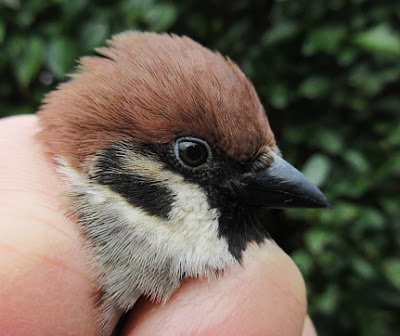
The Tree Sparrow was the first to be ringed in the garden since some juvenile birds trapped in June 2016.
Pete

At this transitional point in the calendar it was interesting to catch some birds coming into breeding condition with several CPs and some developing brood patches (e.g. Dunnocks), whilst others had significant fat deposits and were clearly preparing for migration (e.g. Chaffinch and Blackbird).
Jim had also put up a couple of feeders and nets in a neighbouring garden which was a good, sheltered spot and with the help of a sound lure we caught a few Greenfinches there. Pleased with this, we also reminisced about the days when Greenfinches were your bread-and-butter birds in the garden and hundreds could be processed fairly easily.
In total, we processed 31 birds (21 new/10 retrap), comprising: Great Tit 1/1, Chaffinch 2/0, Blackbird 1/1, Song Thrush 1/0, House Sparrow 2/5, Robin 2/0, Goldfinch 3/0, Dunnock 1/1, Greenfinch 6/1, Starling 2/0, Tree Sparrow 1/0.
The Tree Sparrow was the first to be ringed in the garden since some juvenile birds trapped in June 2016.
Pete


Starling and Tree Sparrow (PML)
Thursday, 22 March 2018
Brackenhurst student demonstrations . . .
. . . no, not over lecturers’ pension rights, but bird ringing demonstrations for the students at NTU, Brackenhurst. Many of them use the Yellowhammer data we collect in their statistics lessons, and the demos allow students to see them in the hand as well as learning about the aims of the Ringing Scheme.
Wednesday 14 March
Despite the blowy south-easterlies, Kev, Louise and myself netted 61 birds. Conveniently, they came in a steady flow through the morning, and our three groups all got to see birds in the hand and release birds. Thirty-eight of our total were our target species, Yellowhammer. The eldest ringed bird was 4 years old. We also ringed nine Reed Buntings.
Species totals: 59 birds (45 new/14 retrap): Robin 1/0, Blackbird 1/1, Blue Tit 0/1, Great Tit 2/1, Goldfinch 2/0, Chaffinch 2/1, Yellowhammer 28/10, Reed Bunting 9/0.
Wednesday 21 March
Colder and calmer initially, then breezy from the west. I thought we would catch more birds than last week, but Gary, Kev, Kirsten, Max Collins and I only managed 36 birds. However, there were fewer students this time and it was enough for them. Yellowhammer (20) and Reed Bunting (6) again dominated the catch. It's been our best winter for ringing Reed Buntings. Not sure why, but perhaps the colder winter and seed mix have both played a part. A nice surprise was to ring a Brambling; only our fourth at the site. The oldest birds were a Robin and a Yellowhammer, both from 2014.
Species totals: 36 birds (18 new/16 retrap): Robin 0/1, Dunnock 1/0, Blackbird 1/0, Great Tit 1/1, Goldfinch 2/0, Chaffinch 1/1, Brambling 1/0, Yellowhammer 8/12, Reed Bunting 3/3.
Jim Lennon


Wednesday 14 March
Despite the blowy south-easterlies, Kev, Louise and myself netted 61 birds. Conveniently, they came in a steady flow through the morning, and our three groups all got to see birds in the hand and release birds. Thirty-eight of our total were our target species, Yellowhammer. The eldest ringed bird was 4 years old. We also ringed nine Reed Buntings.
Species totals: 59 birds (45 new/14 retrap): Robin 1/0, Blackbird 1/1, Blue Tit 0/1, Great Tit 2/1, Goldfinch 2/0, Chaffinch 2/1, Yellowhammer 28/10, Reed Bunting 9/0.
Wednesday 21 March
Colder and calmer initially, then breezy from the west. I thought we would catch more birds than last week, but Gary, Kev, Kirsten, Max Collins and I only managed 36 birds. However, there were fewer students this time and it was enough for them. Yellowhammer (20) and Reed Bunting (6) again dominated the catch. It's been our best winter for ringing Reed Buntings. Not sure why, but perhaps the colder winter and seed mix have both played a part. A nice surprise was to ring a Brambling; only our fourth at the site. The oldest birds were a Robin and a Yellowhammer, both from 2014.
Species totals: 36 birds (18 new/16 retrap): Robin 0/1, Dunnock 1/0, Blackbird 1/0, Great Tit 1/1, Goldfinch 2/0, Chaffinch 1/1, Brambling 1/0, Yellowhammer 8/12, Reed Bunting 3/3.
Jim Lennon


Brambling and student group at ringing station
Monday, 5 March 2018
Sibthorpe, Sunday 4 March
Tom and I dropped by Jim and Elaine's house on Sunday just as the snow began melting and the birds began singing. We spent a pleasant 3 or 4 hours netting at the feeders in the garden and we found most individuals in rude health, despite the cold snap.
We processed 41 birds (24 new/17 retrap) comprising: House Sparrow 13/9, Robin 1/0, Greenfinch 1/0, Great Tit 1/1, Goldfinch 5/0, Chaffinch 1/0, Blue Tit 0/3, Dunnock 1/3, Fieldfare 1/0, Reed Bunting 1/0.
Pete


We processed 41 birds (24 new/17 retrap) comprising: House Sparrow 13/9, Robin 1/0, Greenfinch 1/0, Great Tit 1/1, Goldfinch 5/0, Chaffinch 1/0, Blue Tit 0/3, Dunnock 1/3, Fieldfare 1/0, Reed Bunting 1/0.
Pete


adult female Fieldfare (PML)
Sunday, 25 February 2018
Sutton Bonington, January & February 2018
Sutton Bonington has been rather disappointing for the last two months so I thought a summary would be better than a visit by visit account. A combination of a few things, not many birds at the start of the year, nets not necessarily positioned in the best place and the weather. Two of these are much improved, the birds are now there and new net positions seem to be catching much better. The one thing we have not been able to do anything about is the weather. Our visits are restricted to a Saturday or Sunday and despite trying to follow the forecasts and pick the best day we have been hampered by the wind, rain or snow on every visit so far this year. Yesterday was no different, despite clear skies from the start it was bitterly cold and the easterly wind increased as the morning went on billowing out the nets. I think we were all glad to finish even though we had the best catch of the year with 50 birds.
The various teams this year have consisted of Maria, Kirsten, Alex, Duncan, Sue, Trish, Jake, Tom, Gary and I. Total catches for January and February have been 155 including 62 retraps, made up of (new/retrap): Fieldfare 3/0, Redwing 3/0, Blackbird 3/0, Robin 2/12, Dunnock 4/8, Blue Tit 7/9, Great Tit 3/5, Coal Tit 1/0, Goldcrest 1/0, Long-tailed Tit 0/13, Greenfinch 2/0, Goldfinch 2/0, Chaffinch 6/1, Reed Bunting 12/7, Yellowhammer 43/7, House Sparrow 1/0. The oldest retraps have been from 2015. It is at least good to see that half the birds caught have been Yellowhammers and Reed Buntings.
Thanks to Maria for keeping the feeders topped up during the week.
Kev


The various teams this year have consisted of Maria, Kirsten, Alex, Duncan, Sue, Trish, Jake, Tom, Gary and I. Total catches for January and February have been 155 including 62 retraps, made up of (new/retrap): Fieldfare 3/0, Redwing 3/0, Blackbird 3/0, Robin 2/12, Dunnock 4/8, Blue Tit 7/9, Great Tit 3/5, Coal Tit 1/0, Goldcrest 1/0, Long-tailed Tit 0/13, Greenfinch 2/0, Goldfinch 2/0, Chaffinch 6/1, Reed Bunting 12/7, Yellowhammer 43/7, House Sparrow 1/0. The oldest retraps have been from 2015. It is at least good to see that half the birds caught have been Yellowhammers and Reed Buntings.
Thanks to Maria for keeping the feeders topped up during the week.
Kev


The ringing Base and processing Yellowhammers and Reed Buntings (S. Lakeman)
Brackenhurst Update
Times, they are a changin . . . . Orwin's is being planted up as woodland by Brack students (see pictures), one of three new woodlands going in on the estate this winter. Generally new woodland is to be welcomed, but personally I think Orwin's should have been kept as permanent damp grassland giving another habitat on the estate and more in keeping with the landscape character of the dumble and historic farming patterns. Having said that the emergent woodland will suit bird species like Whitethroat and Willow Warbler.
Results from our last three ringing visits to the supplementary feeding station are follow:-
Saturday 20 January - Species totals: 29 birds (13 new/16 retrap): Treecreeper 0/1, Robin 0/1, Fieldfare 2/0, Redwing 1/0, Blue Tit 4/6, Great Tit 2/6, Chaffinch 0/2, Yellowhammer 2/2. Team – Duncan, Issie, Jim & Sue.
Monday 5 February - Species totals: 45 birds (25 new/20 retrap): Long-tailed Tit 1/1, Goldcrest 1, Robin 0/3, Blackbird 3/1, Fieldfare 2/0, Blue Tit 2/4, Great Tit 2/8, Chaffinch 5/0, Yellowhammer 6/3, Reed Bunting 2/0. Team – Amy, Jim, Kev & Maria.
Thursday 22 February - Species totals: 107 birds (64 new/43 retrap): Treecreeper 1/0, Robin 0/2, Dunnock 3/0, Blackbird 2/2, Blue Tit 2/2, Great Tit 7/9, Chaffinch 4/2, Yellowhammer 34/26, Reed Bunting 8/0, House Sparrow 1/0. Team – Abbie, Duncan, Jim & Tom.
A few highlights
Frost equals good numbers of Yellowhammers ringed & retrapped.
Reed buntings are back, we had none in 2014/15.
Oldest ringed birds were Chaffinch (2015), Great Tit (2014), and three Yellowhammer (2014).
As ever, massive thanks to Simon Taylor for keeping the seed hoppers topped up. We and the birds greatly appreciate it!
Jim Lennon


Results from our last three ringing visits to the supplementary feeding station are follow:-
Saturday 20 January - Species totals: 29 birds (13 new/16 retrap): Treecreeper 0/1, Robin 0/1, Fieldfare 2/0, Redwing 1/0, Blue Tit 4/6, Great Tit 2/6, Chaffinch 0/2, Yellowhammer 2/2. Team – Duncan, Issie, Jim & Sue.
Monday 5 February - Species totals: 45 birds (25 new/20 retrap): Long-tailed Tit 1/1, Goldcrest 1, Robin 0/3, Blackbird 3/1, Fieldfare 2/0, Blue Tit 2/4, Great Tit 2/8, Chaffinch 5/0, Yellowhammer 6/3, Reed Bunting 2/0. Team – Amy, Jim, Kev & Maria.
Thursday 22 February - Species totals: 107 birds (64 new/43 retrap): Treecreeper 1/0, Robin 0/2, Dunnock 3/0, Blackbird 2/2, Blue Tit 2/2, Great Tit 7/9, Chaffinch 4/2, Yellowhammer 34/26, Reed Bunting 8/0, House Sparrow 1/0. Team – Abbie, Duncan, Jim & Tom.
A few highlights
Frost equals good numbers of Yellowhammers ringed & retrapped.
Reed buntings are back, we had none in 2014/15.
Oldest ringed birds were Chaffinch (2015), Great Tit (2014), and three Yellowhammer (2014).
As ever, massive thanks to Simon Taylor for keeping the seed hoppers topped up. We and the birds greatly appreciate it!
Jim Lennon


Monday, 12 February 2018
Recent Recoveries
As usual, our recent recoveries have included a lot of local Barn Owl movements, but nothing particularly out of the ordinary.
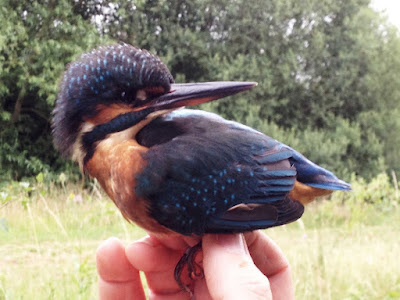
Perhaps the most interesting recovery of the latest batch we have received is that of a Kingfisher that was ringed at Holme Pierrepont last July. We don't get many recoveries of this species, and the bird in question made a long movement down south and was found in Studland, Dorset in January. It was, unfortunately, dead when picked up.
Another Attenborough Cormorant has been re-sighted, this time a bird colour-ringed in July 2016, seen twice at Rutland water in January.
An Attenborough Heron, ringed in April last year has been found dead in Gower, South Wales in December.
An adult female Pied Flycatcher, caught at a nest-box at our site in Wales last summer, had originally been ringed the previous summer in Herefordshire as a chick.
A House Sparrow, ringed in Gary's Garden as a youngster last June, was found dead in a nearby garden on Christmas Day.
Another bird from Gary's Garden, a Goldfinch, has been controlled by ringers in France, at a site in Wirwignes, pas-de-Calais in December. It had originally been ringed in January.
A Blackbird ringed at the beginning of 2015 at Newthorpe, has been controlled by ringers on the Isle of Wight at Hasely Manor, where the Isle of Wight ringing course is held. It was controlled on the 11th June.
A Long-tailed tit, ringed in some allotments in Leicester in March last year, was controlled by the group at the winter site at Sutton Bonington on the 17th December.
Finally, a Blue Tit ringed in the nest by Birklands ringers in Bestwood Country Park during May last year, has been caught by Mick at his site nearby in November. He also controlled another Birklands Blue Tit on the same day, a 1st year bird that had initially been ringed at the country park in October.
Tom
Perhaps the most interesting recovery of the latest batch we have received is that of a Kingfisher that was ringed at Holme Pierrepont last July. We don't get many recoveries of this species, and the bird in question made a long movement down south and was found in Studland, Dorset in January. It was, unfortunately, dead when picked up.
Another Attenborough Cormorant has been re-sighted, this time a bird colour-ringed in July 2016, seen twice at Rutland water in January.
An Attenborough Heron, ringed in April last year has been found dead in Gower, South Wales in December.
An adult female Pied Flycatcher, caught at a nest-box at our site in Wales last summer, had originally been ringed the previous summer in Herefordshire as a chick.
A House Sparrow, ringed in Gary's Garden as a youngster last June, was found dead in a nearby garden on Christmas Day.
Another bird from Gary's Garden, a Goldfinch, has been controlled by ringers in France, at a site in Wirwignes, pas-de-Calais in December. It had originally been ringed in January.
A Blackbird ringed at the beginning of 2015 at Newthorpe, has been controlled by ringers on the Isle of Wight at Hasely Manor, where the Isle of Wight ringing course is held. It was controlled on the 11th June.
A Long-tailed tit, ringed in some allotments in Leicester in March last year, was controlled by the group at the winter site at Sutton Bonington on the 17th December.
Finally, a Blue Tit ringed in the nest by Birklands ringers in Bestwood Country Park during May last year, has been caught by Mick at his site nearby in November. He also controlled another Birklands Blue Tit on the same day, a 1st year bird that had initially been ringed at the country park in October.
Tom

The Kingfisher that went to Dorset...
Monday, 15 January 2018
Brackenhurst - Sunday 14 January
In between the winds, Duncan, Kev, Kirsten, Sue and myself got another session in at the feeders at Brackenhurst. The weather was cool, calm and cloudy; ideal for ringing. We caught birds steadily over the morning, and finished on a total of 93 birds processed.
Highlights were:-
Jim

Highlights were:-
- Yellowhammer – 32 birds processed, and we now have had 70+ birds this winter. This is already more than the very mild winters of two and three years ago. So, definitely a correlation between mean temperature and birds coming to the feeders. The oldest retrap was from winter 2013/14.
- Song Thrush – only our sixth bird in 10 years, but the second of this winter and the first to be caught at the feeders.
- Great Tit – it's not usual to get an influx of unringed birds this time of year, but 13 is unusual. It shows there’s still stuff to learn about our so called sedentary resident bird species.
- Chaffinch – we had an old bird originally ringed in winter 2011/12.
- It can be tricky to determine if Yellowhammers are juveniles or adults. One of the ageing criteria we use is to look for different generations of feathers in their tertials. See photo below which shows a Yellowhammer with different generations, which makes it a juvenile first winter bird.
Jim

Yellowhammer showing two generations of tertials making it a first-winter bird. (JL)
Tuesday, 9 January 2018
Brackenhurst, Tuesday 9 January
Diaries and the winds meant this was to be the first New Year visit to the feeders at Brackenhurst. It was a cold, dreich January morning, and we never saw the sun at all. However, Kev spotted a Tawny Owl flying away from us in the gloom as we drove up. We were Duncan, Issie, Kev and myself.
Catching was steady through the session with 70 birds processed. Highlights were:
All of the retraps were first ringed at Brackenhurst, with the oldest retrap a Blue Tit after nearly 4 years, ringed as a juvenile in December 2013 and previously retrapped twice in 2014 at the same site.
Jim Lennon

Catching was steady through the session with 70 birds processed. Highlights were:
- 18 Blue Tits – the highest number for some time.
- Yellowhammers – nice to finally get amongst them this winter with 26 individuals processed.
- Uncommon species – Treecreeper and Bullfinch are barely annual at the site, and it was nice to see them in the hand again.
All of the retraps were first ringed at Brackenhurst, with the oldest retrap a Blue Tit after nearly 4 years, ringed as a juvenile in December 2013 and previously retrapped twice in 2014 at the same site.
Jim Lennon

Treecreeper (Isabel Connell)
Monday, 8 January 2018
Sutton Bonington, Sunday 7 January
I thought we were going to have a team of nine for the first session of the New Year at Sutton Bonington, but two fell ill and dropped out and I was not feeling 100% (by the evening I had lost my voice). Having baited up the site a couple of times over the holidays and not seen many birds there I thought we may end up with more ringers than birds – and I was nearly right!
It was a bitterly cold day, the wind chill making it particularly unpleasant and ultimately the strength of the wind affected the nets too much, enforcing an early finish. The team consisted of Kirsten, Alex, Duncan, Trish, Jake, Gary and I.
We ended with a catch of just 15 including 6 retraps. The catch was made up of (new/retrap): Fieldfare 2/0, Redwing 2/0, Blackbird 1/0, Robin 0/5, Blue Tit 1/0, Great Tit 1/0, Goldcrest 1/0, Long-tailed Tit 0/1, Yellowhammer 1/0. The oldest retrap was from 2015.
Kev
It was a bitterly cold day, the wind chill making it particularly unpleasant and ultimately the strength of the wind affected the nets too much, enforcing an early finish. The team consisted of Kirsten, Alex, Duncan, Trish, Jake, Gary and I.
We ended with a catch of just 15 including 6 retraps. The catch was made up of (new/retrap): Fieldfare 2/0, Redwing 2/0, Blackbird 1/0, Robin 0/5, Blue Tit 1/0, Great Tit 1/0, Goldcrest 1/0, Long-tailed Tit 0/1, Yellowhammer 1/0. The oldest retrap was from 2015.
Kev
Sunday, 7 January 2018
Green Woodpeckers
A quick look through the BTO online ringing and nest recording report shows that around 300 to 400 Green Woodpeckers are ringed annually in Britain and Ireland. A search of our own totals in DemOn (yes, DemOn!) shows that we have ringed 42 new and retrapped 5 Green woodpeckers since 1997.
They are a green-listed bird and by no means rare around here but they are still an unfamiliar bird in the hand and therefore ageing often requires reference to the “Identification Guide to European Non-passerines” by Kevin Baker. However, when faced with single birds of unfamiliar species, it can still be tricky to interpret the descriptions and pictures in this book (unfortunately I still have an “old” copy). But occasionally you get lucky and catch a really helpful bird...
This male Green woodpecker was caught at Hazelford Island on 22 December 2017 and its mixed-age plumage shows very well the different tertial patterns described by Kevin Baker.
Mick P

Subscribe to:
Posts (Atom)