Pages

Tuesday, 29 August 2023

Portland Bird Observatory Visit, 18-27 August

As part of broadening my ringing experience, I visited Portland Bird Observatory in Dorset for just
over a week this August, hoping to catch part of the autumn migration.

The Observatory is situated in the Old Lower Light near Portland Bill, providing accommodation for
up to 24 guests to monitor birds in the area. Since its inception in 1961, over 250,000 birds have
been ringed at Portland Bird Observatory.

My visit began at the tail end of a storm, limiting ringing opportunities for the first day. The
weather then settled down and warmed up for the rest of the week, bringing in some migrants.
The main species ringed were Goldfinch, Willow Warbler, and Sedge Warbler. I was introduced to
some new species for me to ring, such as Stonechat, Grey Wagtail, Grasshopper Warbler, Spotted
Flycatcher, and Wheatear. On the Monday, a Melodious Warbler was caught in the net, giving me a
great opportunity to ring this rare bird. It remained in the area, when it was later re-trapped on the
Tuesday and Saturday.

By setting various tapes, we managed to target Swallows, Sand Martins and Tree Pipits in the fields. Efforts were made to spring trap Rock Pipits as part of a colour ringing project, but with no success while I was there.

Moth-trapping is a daily occurrence at the Observatory. I had never engaged with it before, but was
helped by many knowledgeable people to get to grips with the common species. I have been
inspired to continue this activity and expand my knowledge in the future.

Many thanks to Martin, Jodie and Mark for being so welcoming and helpful throughout my stay.

Joshua

Stonechat

Melodious Warbler

Grey Wagtail


Wheatear


Skylarks NR – Monday 28 August

At last a day offering good mist-netting weather, unfortunately it proved to be of no help in producing a good catch. Last year at this site on this day, with the same nets, we caught 83 birds including 20 Blackcap, 20 Chiffchaff and 15 Reed Warblers along with 22 resident species. Can’t be sure about recent low catches here and elsewhere, but along with degrading habitat I think it has been a terrible breeding season, at least locally. Today we had a catch of just 22 birds including just 4 Blackcaps, 8 Chiffchaffs, 1 Reed Warbler and just 5 resident species. Based on recent catches the coming winter looks as though it may be difficult to catch many resident species at our sites.

Kev

Tuesday, 22 August 2023

Isle of May, 12-20 August

Myself and Kev B were lucky to have the opportunity to visit the Isle of May this year, alongside Frank and Shelagh from Watchtree Ringing Group, Mike from Carlisle and Bob from Durham.

The Isle of May is a National Nature Reserve and the UK’s second oldest Bird Observatory, situated in the mouth of the Firth of Forth, Scotland. Teams of up to six ringers, birdwatchers and other naturalists are able to stay at the ‘Low Light’ for week-long periods to monitor the flora and fauna. It’s perfectly situated to track Autumn migration from Scotland and Scandinavia.

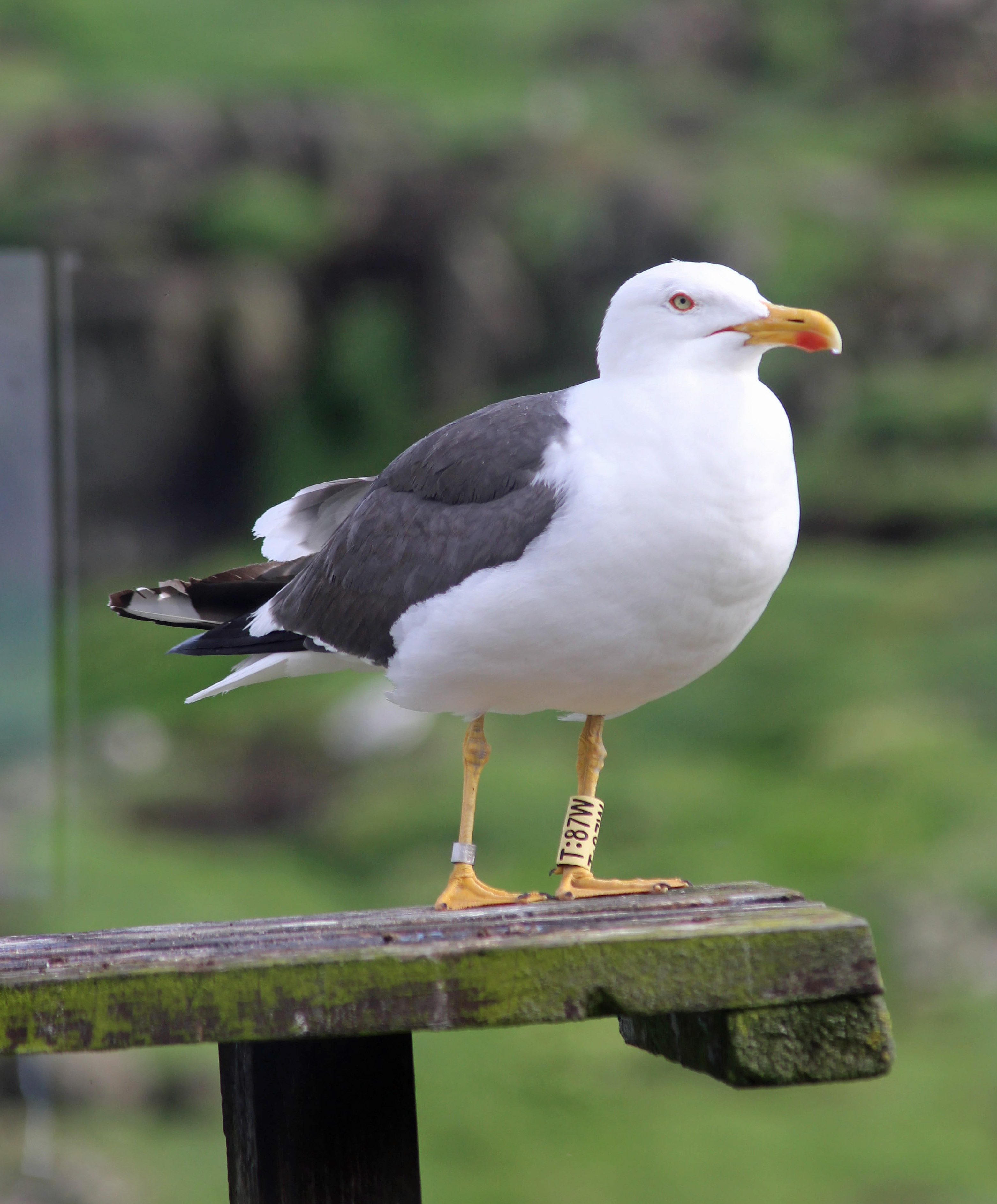
The start of the week was mostly warm and sunny, and we caught a small but steady stream of Willow Warblers using mist nets and Heligoland traps. Juvenile Puffins and Lesser Black-Backed Gulls were caught by hand while still flightless. The previous group mentioned that there had been 3 Short-eared Owls, so we tried to catch these at dusk, succeeding on the third attempt. At night, we aimed to catch some of the island's newly discovered breeding Storm Petrels.

The second half of the week took a turn as Storm Betty hit the mainland with easterly winds gusting over 35mph, putting a stop to much of our ringing efforts. We received news that we’d be stuck on the island an extra day. As luck would have it, the easterlies had pushed early migrating birds out over the North Sea and on the morning of the final day the mainland was obscured by thick sea mist, making the Isle of May the first and only landfall for any birds caught by the wind. We had Pied Flycatchers with 18 ringed, mixed with Tree Pipit, Redstart, Red-Backed Strike, Icterine Warbler and Barred Warbler. Our extra day stuck on the island turned out to be the best!

Thanks to Mike for organising the trip, and the warden David Steele for bringing us tea and milk when we’d run out. 

Holly


Monday, 21 August 2023

Ramsdale Park Golf Club - Sunday 20 August

We have been trying to run a session here for a while but as access is difficult during the week and every weekend seems to have been breezy, we had not managed it. So with a potential gap in the wind and rain we got there on Sunday, the wind was stronger than forecast but we put up all the usual nets and had 5 mp3 lures playing: three playing warblers, one Linnet and one Tree Pipit (August being peak passage month for Tree Pipit). Overall the site was quiet and although we caught more warblers than other species the numbers were generally low with only 4 Blackcaps in the 44 birds we finished on. The same weekend last year we had 13 Blackcaps in the catch. The other mp3s were successful, one producing a single male Linnet in the middle of its main moult and the other 3 Tree Pipits. It is unusual to get a Tree Pipit in any year so to get 3 on one day was nice.

Kev

Linnet (KJH)

Tree Pipit (KJH)


Friday, 18 August 2023

Skylarks NR - Sunday 13 August

Hopeful of a better catch today with the forecast dry and not too breezy, but as usual these days the forecast was wrong. It rained twice during the morning, the worst just as we were going to take down, so the nets were quickly closed but still got soaked! The catch was marginally better at 48, but Blackcaps still seem to be lower in numbers than previous years, we caught 11 today. The only bird of note today was a Willow Warbler with a greyish tinge, particularly on it’s wings (see photo).

Kev


Friday, 11 August 2023

Skylarks NR - Saturday 6 August

A pretty slow day ringing at HPP, only 35 individuals caught during the session. A rare visitor to the nets, a Sparrowhawk, quickly ringed and released but not before he got last laugh by drawing blood with a well placed talon. The slow morning left lots of down time to eat this session's baked goods - pumpkin loaf.

Jake


Tuesday, 1 August 2023

Skylarks NR, Tuesday 1 August

Any break in the weather is worth an attempt to put a net up at the moment, so three of us had a
mid-week session at Skylarks this morning. We caught a total of 49 birds, with a nice mix of
warblers - Blackcap, Whitethroat, Sedge Warbler, Reed Warbler, Garden Warbler, Chiffchaff and
Willow Warbler.

We didn’t retrap any of the 150+ birds ringed on recent site visits, which just goes to show how
birds are constantly moving through the site.

Pictured is a Blackbird undergoing an irregular moult in the right wing. Primary 10 is old, it has replaced primaries 9-5 and started moulting its secondaries.

Holly


Monday, 31 July 2023

More on moult

Continuing the theme of arrested/suspended moult I searched through some of our Demon records today. Between 1/1/18 and 1/1/23 we have processed 28,754 birds; of these, 17 are recorded as having arrested their moult (as arrested is the only option in Demon, I will just use this term from now on).

Of these 10 were female:
1 – Lesser Redpoll
1 – Whitethroat
2 – Greenfinch
6 – Goldfinch

5 were male:
1 – Garden Warbler
1 – Greenfinch
3 – Goldfinch

and 2 were unsexed:
1 – Whitethroat
1 – Goldfinch (though provisionally sexed as a female).

These totals don't include Holly's whitethroat, or my Linnet (see below), as these were recorded as in main moult but looking likely to have arrested their moult, which makes me wonder how many others were like this. (Also, its unlikely we would have recorded arrested moult in the secondary feathers).

Two things which jump out from our totals are -
1 - the number of Goldfinch. Could it be that perhaps we have caught more of these or perhaps a moult limit is easier to see, I don't know.
2 - the number of males. The article – Moult interruption in passerines resident in Britain by D G C Harper, found that this had only been recorded in females, though more information was needed.

And a final word from D G C Harper in their 1984 article -

“The increasing number of non-migratory birds in which moult interruption associated with breeding has been recorded suggests that ringers should pay careful attention to birds caught during the moult period that are not in active moult. Although the paucity of previous records of moult interruption in such species is probably a reflection of the low frequency with which it occurs, it may also reflect a tendency for observers to assume that birds whose feathers are all fully grown have either not started or have completed their moult”.

Mick P

Sunday, 30 July 2023

Ramsdale Park Golf Centre - Saturday 29 July

Avoiding a Triathlon event at Skylarks, we met at Calverton Golf Club this morning on a bright
and breezy day. Not ideal conditions for our rides at the Golf Club, which are pretty exposed.
But we still managed a solid catch of 40 birds, mostly young warblers with 4 adult retraps.

Following on from Mick P’s post below, we also had a Whitethroat that appeared to be
arresting/suspending its moult, though it did have one primary still in pin (see photo).

We talked about the possibilities of using traps in the garden while it’s too windy to use mist
nets, and Josh shared a delicious homemade chocolate cake.

Holly


Sunday, 23 July 2023

Arrested or Suspended - who knows?!


This female linnet caught this morning prompted me to look at the confusing issue of arrested or suspended moult.

Although still in main moult with a primary moult score, on both wings, of 5400000000, it looks possible that it wont drop any more primary feathers, so it may have arrested or suspended its main moult. But which is it?

Moult and Ageing of European Passerines by Lukas Jenni and Raffael Winkler says –

'Following Harper (1984), the phenomenon by which a moult stops before the whole plumage has been renewed is called moult interruption. This term and the related terms suspended and arrested moult have generally been used only for primary and secondary moult and, in order to prevent confusion, we retain this usage. Two different types of primary and secondary moult interruption are recognized (King 1972, Harper 1984). In the case of suspended moult, the primary and/or secondary moult is subsequently resumed at the point of interruption. Thus, the suspension normally divides a single moult into two temporally separated phases. Those primaries and secondaries not moulted during the first phase of the moult are renewed later during the second phase. In the case of arrested moult, the next primary and secondary moult starts at the normal site of initiation or another site other than the point of interruption. Thus, an arrested moult cannot later proceed to completion and the subsequent moult is in fact a different moult entirely.'

So, unless this bird is retrapped before its next “recognised” moult cycle its impossible to say if it has arrested or suspended its moult. However the “BTO Moult code flowchart for birds age 4, 5, or 6” (and DemOn) only gives the option to record arrested moult (perhaps here used synonymously with Jenni & Winkler's moult interruption), so if it had finished its main moult it would have to have been reported as arrested moult.

A further search of the internet found one of the articles referred to above by Jenni & Winkler - Moult interruption in passerines resident in Britain by D.G.C. Harper. This contains the following statement –

'Moult interruption during breeding has also been reported in unpublished studies on Whitethroat Sylvia communis, Willow Warbler Phylloscopus trochilus, Linnet Carduelis cannabina and Yellowhammer Emberiza citrinella (R.A. Cawthorne cited in Ginn & Melville 1983; M. Lawn cited in Boddy 1983; and M. Boddy cited in Boddy 1983). Unfortunately no details have yet been published. It is however interesting that only females are mentioned in these reports; this raises the possibility that moult interruption in these species is more prevalent among females than among males. All these instances are reported as involving moult suspension; evidence supporting this interpretation would be valuable.”

I've also seen this in a female Whitethroat (see our Blog for August 2020). Interestingly, I also retrapped this female in September 2021 and it appeared to have Arrested its moult again.

Mick P

Thursday, 20 July 2023

Skylarks NR - Tuesday 18 July

A break in the weather - Tuesday was the only dry and still morning for weeks, so we put the nets up at Skylarks and hoped for the best. With the help of sound lures we managed to catch 104 birds - by far our best catch of the year. Over 90% of the birds processed were juveniles, mostly Blackcaps and Reed Warblers. Highlights included Reed Bunting, Sedge Warbler, Treecreeper, and Mick P’s first Cetti’s Warbler.

With this being the first big catch of juveniles, it seems likely that nesting was late this year owing to the the weather. Fingers crossed for more evidence of breeding success.

Holly


 Song Thrushes, Treecreeper and Reed Warbler, Skylarks NR, 18 July 2023 (H. James)

Monday, 10 July 2023

Skylarks NR - Sunday 9 July

A very humid start to the day at Skylarks produced fewer birds than last week, with 48 in total. This included a large number of juvenile Reed Warblers, as well as a Whitethroat and 4 Greenfinch. A few Sedge Warblers are present at the site and have now been recaptured a number of times.

Alex


Reed Warbler and Robin (J. Holness) and Sedge Warbler (A. Turnbull)


Tuesday, 4 July 2023

Skylarks NR – Sunday 2 July


Despite the breeze on Sunday, we recorded our best ringing session so far this year. At Skylarks, we caught a total of 60 birds, many of which were juveniles. Highlights included a Greenfinch, a flock of 4 juvenile Great Tits, a Whitethroat and a Lesser Whitethroat (pictured). 

Joshua